
Vendor & Supply-Chain AI Risk
The riskiest AI in your business is the AI you didn't buy.
The AI showing up in your business is arriving through the SaaS you already trust, not through anything you set out to buy. Find it, follow where your data goes, and score every vendor against the frameworks your regulator and board ask about.
You start from a pre-assessed vendor baseline instead of a blank 40-question cycle.
Built in Norway & the UK · EMEA-sovereign by default
The product
Every vendor's AI, scored and mapped
The register your security team gets on day one — risk score, training posture, EU AI Act mapping and DPA coverage per vendor.
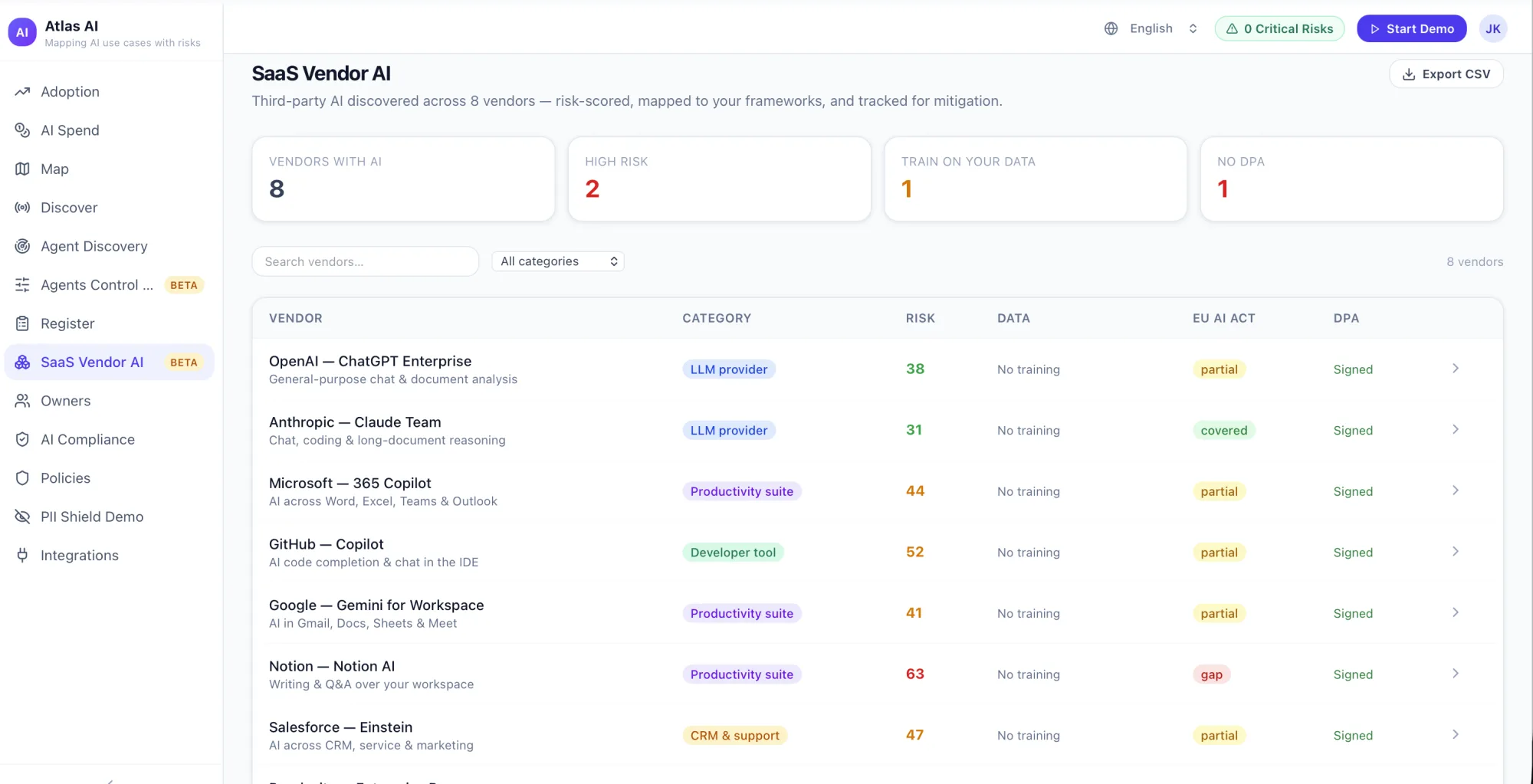
Third-party AI, risk-scored and framework-mapped
The AI inside the SaaS you already bought — scored for risk, checked for whether it trains on your data, mapped to the EU AI Act, and tracked for DPA coverage.
The problem
Your vendors turned on AI. Nobody told security.
Nearly every organisation was hit by a SaaS- or AI-ecosystem security incident last year. The common thread: AI features that shipped inside trusted tools, touching real data, with no review and no entry on any inventory.
AI arrived through procurement, not security
Vendors ship AI features in a product update. No review, no sign-off, no entry on any list.
Questionnaires can't keep up
A 40-question SIG cycle takes a quarter and is stale on arrival. Vendors ship AI faster than you can survey them.
Your data is the supply chain
Vendor AI routes your customer data, contracts and code through models and sub-processors you never contracted with.
The obligation lands on you
Under the EU AI Act you are the deployer. “The vendor handles it” is not a defensible answer to a regulator.
What CISOs need to see
Nine questions every CISO must be able to answer
Vendor AI risk rarely comes down to a single yes or no. It's a set of answers you should be able to produce on demand for any tool, whether an auditor asks or the board does.
Which of our vendors quietly shipped AI?
The AI you didn't procure is already live inside the SaaS you trust, bolted onto your CRM, your helpdesk and your IDE. You can't assess what you can't see.
Where does our data go — and is it training a model?
What does the feature ingest, is your data used to train or fine-tune, can you opt out, and does any of it leave the EU?
Which models and fourth parties sit behind it?
One AI feature can call a foundation model, which calls another API. It's a nesting doll of sub-processors most discovery tools never see.
Does the vendor govern its own AI?
Do they run recognised frameworks like ISO 42001 and NIST AI RMF, with human oversight, red-teaming and an audit trail? Or are they shipping AI with no controls of their own?
What happens when the model drifts or goes dark?
Ask about retraining cadence, change notifications and failover. If the vendor's AI degrades or gets pulled, what breaks in your workflow?
Can one assessment satisfy every obligation?
Map a vendor once against EU AI Act deployer duties, DORA third-party ICT, NIS2, ISO 27001 and SOC 2, and reuse that evidence everywhere it's needed.
Do our contracts give us audit and exit rights?
You want the right to audit, the right to exit, and notice of any material AI or sub-processor change. These are the protections regulators now expect.
Is this a one-time questionnaire or a live signal?
Vendor posture can change the day after you assess it. Point-in-time due diligence has to become continuous monitoring.
Can we show the board the register on demand?
You want a live inventory of every vendor's AI that's risk-scored, owned and audit-ready, not a spreadsheet rebuilt the night before the meeting.
The supply chain
Follow the data, not the contract
You signed with one vendor. Your data may travel through three more. Every hop is a place it can be retained, trained on or exposed, and a place your contract probably never reached.
Your data
Customers · contracts · code
SaaS vendor
The tool you bought
Foundation model
OpenAI · Anthropic · Google
Sub-processors
Fourth parties you never signed
“Your third party's sub-processor is your fourth party — and the regulator still calls it your data.”
Why it's board-level now
Four regulations now point at your vendors' AI
Third-party AI moved from a procurement footnote to a named obligation. As the deployer, you carry the accountability, even though the vendor is the one who shipped the feature.
EU AI Act
As a deployer (Art. 26) you must use third-party AI within the provider's instructions, ensure human oversight, and keep records. High-risk obligations phase in from 2 August 2026.
DORA
Financial entities must register every ICT third party — AI providers included — with pre-engagement due diligence and contractual audit and exit rights.
NIS2
Supply-chain security is a board-level duty. You're accountable for the security posture of the vendors embedded in your essential services.
ISO 42001 & NIST AI RMF
Vendor AI is in scope of your AI management system. Map each vendor to the controls so one assessment serves your certification and your auditors.
How to mitigate it
The vendor-AI mitigation playbook
Eight controls that take SaaS vendor AI from an unmanaged exposure to a governed, auditable part of your supply chain, whatever tools your teams adopt next.
Keep a live vendor-AI inventory
Discover AI continuously, not once a year. An inventory that updates itself is the only one that's still true when the regulator calls.
Minimise and mask the data
Apply DLP and on-device redaction before data reaches a vendor's AI, and switch off training on your data wherever the vendor allows it.
Map and gate sub-processors
Require vendors to disclose their model providers and downstream processors — and approve the chain before sensitive data flows through it.
Tier vendors by risk
Classify each vendor by data sensitivity and business criticality, and scale the depth of due diligence to the tier instead of assessing everything equally.
Harden access and egress
Enforce SSO and least privilege, scope API keys narrowly, restrict egress, and keep a kill-switch to cut a vendor off fast.
Put AI clauses in the contract
Negotiate audit rights, exit rights, a training opt-out, and notice of material AI or sub-processor changes while you still have leverage, before you sign.
Monitor and re-trigger
Watch for new AI features, model updates and posture drift, and re-open the assessment automatically when a vendor's risk profile changes.
Plan the exit and the outage
Define data deletion on exit, failover, and a contingency for the day a model is restricted or pulled, so no single vendor becomes a single point of failure.
How Prompt Shields answers it
From a blank questionnaire to a living vendor register
Atlas AI discovers the vendor AI in your stack, scores it from a baseline Prompt Shields already maintains, and keeps it current, so vendor due diligence stops being a quarterly fire drill.
Step 1
Discover the vendor AI in your stack
On-device and integration-based discovery surfaces the AI embedded in the SaaS you already use — including the tools no SSO log or API connector reveals.
Step 2
Start from a pre-assessed baseline
Prompt Shields has already assessed the common AI vendors, covering their underlying models, the data those models touch and the use cases, and keeps it current. You inherit that work instead of mailing out questionnaires.
Step 3
Score risk against every framework
Each vendor is mapped to the EU AI Act, DORA, ISO 42001, NIST AI RMF and the OWASP LLM Top 10, with gaps ranked by criticality and deadline.
Step 4
Monitor continuously
Posture changes, new sub-processors and model updates raise a signal — so your register stays true between assessments, not just on the day you ran one.
The vendor assessment is already done
You don't start from a blank questionnaire. Build on the vendor AI assessment Prompt Shields has already done and keeps current, and spend your time on your own context instead of months of third-party due diligence.
Leverage work already done
Inherit a maintained map of each vendor's AI instead of re-running due diligence from scratch.
Save the assessment effort
Skip the 40-questionnaire cycle and the quarter-long wait. Start from a pre-assessed baseline on day one.
Understand models, data and use cases
See the underlying AI models, the data they touch and the use cases, the substance your board and auditors actually ask about.
Know your vendors' AI before your auditor asks.
A 30-minute walkthrough: how Atlas AI discovers the AI inside your SaaS, maps the supply chain, and scores every vendor against the EU AI Act, DORA, ISO 42001 and NIST AI RMF.