
Azure OpenAI & AI Foundry
Your Azure credits are going on the wrong model.
Most of what a product sends to a frontier model is classification, extraction and routine drafting that a smaller deployment handles for a fraction of the price. We find that work, price the swap, and hand you the list — inside the Azure tenant you already run.
We are in Microsoft for Startups ourselves, so the credit clock is one we watch too.
Ask for a cost review
Tell us where your models run and we will come back with what we would look at first.
No obligation, no sales sequence. One reply from a human. Protected by reCAPTCHA.
The problem
Nobody sets out to overpay for tokens
The bill does not say which model
Azure Cost Management shows what you spent. Joining that to tokens per model and per deployment is the part it makes hard, so the line that is actually burning the credits stays hidden.
Most calls do not need the big model
Classification, extraction, tagging and routine drafting make up a large share of traffic and run on a small model for a fraction of the price. Teams standardise on the frontier model because it is the safe default, not because the work needs it.
Credits run out before the runway does
Startup credits feel free until the month they are not. Finding out from the invoice is the expensive way to learn which use case was the costly one.
What you get back
The spend, and the specific swaps worth making
Not a dashboard to go and interpret. A short list of changes, each with the saving next to it and the reasoning you can argue with.
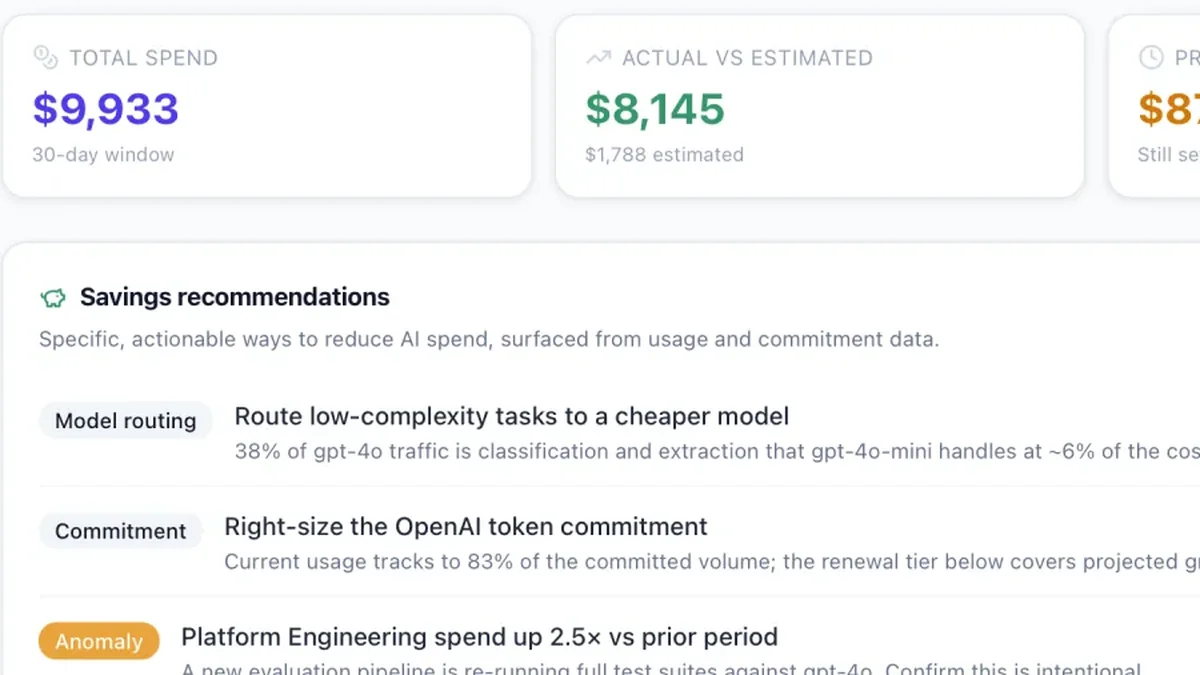
Spend you can attribute
What each model and deployment costs, measured against what was estimated, so an unexpected invoice becomes a line you can point at.
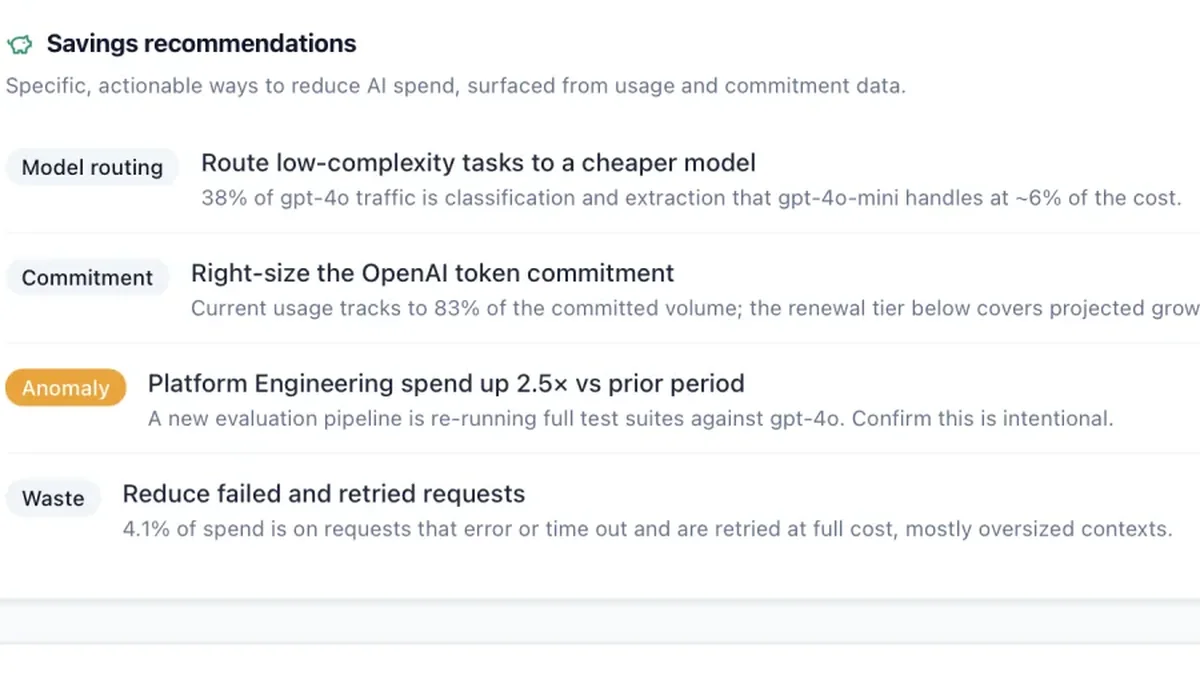
The cheap wins, priced
The share of traffic a smaller model would serve, what the change is worth a year, and the waste that is just failed calls being retried at full price.
Screens are from Atlas AI, shown with the seeded demo dataset used in our walkthroughs. They show vendor and model spend generally, not an Azure-only view.
How it works
Read-only, and out of your request path
- 1
Connect read-only
Reader access to the subscription, or the SDK in front of the calls your code already makes. Nothing is proxied through us and no prompt content is needed to do the arithmetic.
- 2
Join cost to tokens
Spend per model and per deployment, with the effective cost per million input and output tokens, and how it has drifted.
- 3
Match model to use case
Each workload is sorted by what it actually demands. The ones a smaller deployment can serve are listed with the saving attached, and the ones that genuinely need the frontier model are left alone.
- 4
You make the change
You get the list, the numbers and the migration order. We do not sit in your request path, and we do not switch anything on your behalf.
Honest scope
In developmentThe review above is work we do with you today, using Atlas AI and the open-source SDK. The Azure-native product behind it — one Reader role to connect, cost joined to tokens per deployment, PTU utilisation and idle provisioned capacity, budget alerts — is still being built. It runs on demo data at the moment, so we are not selling it yet.
AWS Bedrock and GCP Vertex are further down that roadmap again. If that is where you run, say so on the form: it registers interest and counts towards what gets built next. It does not book a review we cannot yet deliver.
Already know the spend is fine, and the sprawl is the problem?
The AI Sprawl Audit is the other half: the agents, copilots and internal tools nobody owns, found and given an owner or a shutdown date. The Developer SDK is how the measurement happens, and it is Apache 2.0.
Find out what the wrong model is costing you
A short review, read-only, inside your own tenant. If the answer is that your spend is already sensible, we will tell you that and there is nothing to buy.